Emotional Fragility and the Need for a Raft in Intensive Therapy
This article is intended for therapists and clinicians working in intensive, experiential, or ISTDP-informed depth therapy.
Emotional difficulty in therapy is not always a matter of resistance or insufficient motivation. In some cases, the emotional intensity of the work exceeds the client’s capacity to tolerate it. When depth is pursued without adequate stabilisation, anxiety rises quickly, defensive functioning increases, and both client and therapist can feel stuck.
Building capacity before pursuing intensity is not a retreat from depth. It is often the condition that makes depth work possible.

A raft provides stability before movement; without it, depth becomes overwhelming.
Why this discussion matters
Therapists drawn to depth-oriented work often value direct emotional contact and are comfortable working close to affect. Yet certain clients reliably generate a pattern where:
Sessions escalate rapidly
Anxiety rises beyond tolerance
Progress becomes unclear
Both therapist and client leave feeling ineffective
These situations are often interpreted as resistance or lack of engagement. In many cases, however, the central issue is a matter of safe, slow and gentle capacity building.
Emotional fragility is not resistance
Emotional fragility refers to limited capacity to tolerate emotional activation without destabilisation.
Following the fragility spectrum described in ISTDP literature, fragility can be observed through:
How quickly anxiety escalates when affect is mobilised
The nervous system’s ability to remain regulated under pressure
The degree of internal alignment between different parts of the self
Fragile clients are often motivated and insightful. What is limited is not willingness, but internal safety and tolerance.
The cost of misreading fragility
When fragility is mistaken for resistance, therapists often increase intensity:
More pressure toward affect
Stronger challenge of defences
Increased insistence on staying with feeling
The result is predictable:
Anxiety escalates
Defensive organisation becomes more rigid or fragmented
Splitting or projective processes increase
Alliance strain becomes more likely
Therapists may then experience urgency or self-doubt, assuming insufficient pressure is the problem.
The issue is rarely about intensity itself, but about intensity applied without sufficient capacity.
What the “raft” represents
The raft refers to the stabilising capacities that allow depth work to proceed without overwhelming the client.
These include:
Sufficient anxiety regulation to prevent flooding or collapse
Basic affect tolerance
Internal alignment between protective parts and therapeutic aims
A strong enough alliance to tolerate rupture and repair
Reflective capacity that allows observation of experience rather than total immersion in it
Without these elements, pressure tends to mobilise danger rather than insight.
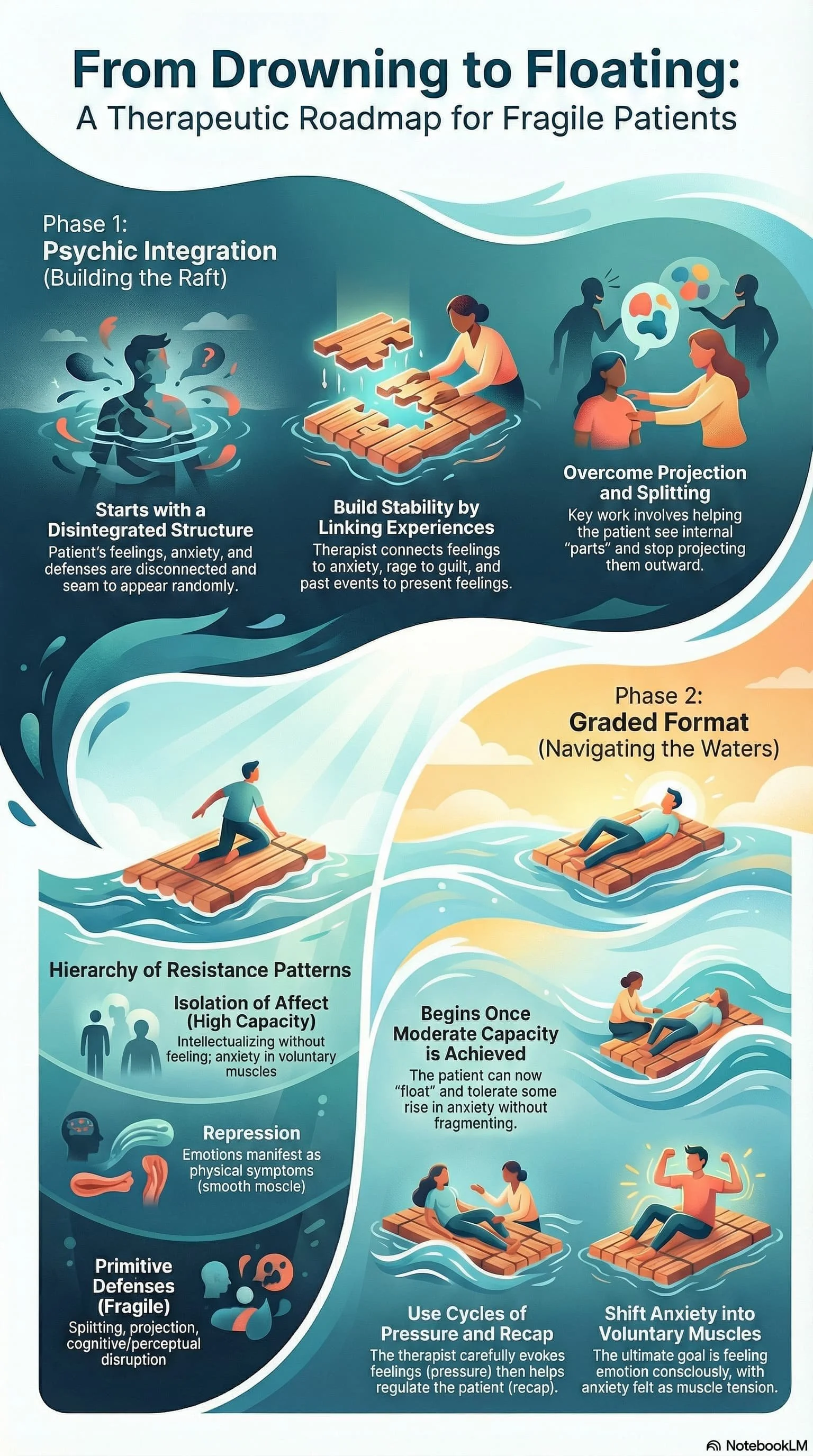
From Drowning to Floating: A Therapeutic Roadmap for Fragile Patients
Parts work before graded affect work
In fragile presentations, internal parts are often in conflict:
One part seeks change
Another fears exposure
Another attacks the self for not progressing
Pressing toward core affect under these conditions often intensifies internal conflict.
Parts-oriented work helps create internal cooperation by:
Acknowledging protective functions
Reducing internal threat
Lowering anxiety
Increasing tolerance organically
Seen this way, parts work is not separate from depth. It is often a prerequisite for graded work becoming effective.
Therapist pull and countertransference
Fragility dynamics commonly evoke strong therapist responses:
Urgency to produce movement
Rescue impulses
Irritation with perceived stagnation
Self-doubt or over-responsibility
These reactions often indicate that the therapeutic structure is exceeding the client’s current capacity.
When therapists respond by increasing pressure, they may inadvertently recreate the client’s internal critical system.
Working responsibly on the fragility spectrum
Depth work requires ongoing discrimination between mobilising affect and building capacity.
This often means:
Prioritising containment over intensity
Tolerating slower progress without self-criticism
Recognising that slower pacing can be technically demanding
Allowing extended periods of stabilisation when necessary
Clinical restraint is a technical decision shaped by the client’s regulatory capacity.
A closing orientation
Emotional fragility requires adjustment rather than escalation. When therapist and client are allowed to slow down and build sufficient stability, depth often becomes accessible without force.
The paradox is that careful containment frequently allows deeper work to emerge more naturally and safely.
If this reflection resonated, you might explore:
Feelings, Anxiety and Defences Across Therapeutic Modalities
Explore more in depth
Frequently Asked Questions About Emotional Fragility, Containment, and Capacity in Intensive Therapy
-
Resistance usually involves capacity with avoidance: the client can tolerate affect but actively deflects or defends against it.
Fragility involves limited capacity: affect mobilisation quickly produces anxiety, disorganisation, shutdown, or harsh superego attack.
A simple test:
If pressure reliably produces more clarity over time, you’re likely dealing with resistance.
If pressure reliably produces more anxiety, confusion, or collapse, fragility is the more accurate frame.
-
Common early indicators include:
rapid shifts from emotion to confusion or blankness
escalating bodily anxiety (tight chest, dizziness, nausea)
sudden intellectualisation or excessive reassurance-seeking
a sharp rise in self-attack after sessions
These are not failures. They are signals that containment needs strengthening.
-
Slowing down is therapeutic when it increases capacity.
It is avoidant only when it preserves stagnation.
The question is not speed, but trajectory:
Is the client becoming more regulated under affect?
Is anxiety decreasing over time?
Are parts becoming less oppositional?
If yes, the work is moving forward, even if it looks quiet.
-
Parts work becomes depth work when it:
reduces internal conflict
weakens the punitive superego
increases affect tolerance
If parts work results in greater emotional access later, it has done its job.
If it becomes endlessly explanatory or reassuring, the focus may need recalibration.
-
This is common, especially in fragile presentations.
Often one part is requesting pressure while another part is terrified of it. Taking the request at face value can unintentionally ally with internal pressure and increase anxiety.
A containing response is to explore:
which part wants pressure
what it fears if pressure is not applied
what happens when pressure increases
This preserves collaboration without escalating risk.
-
Graded work tends to become viable when:
anxiety peaks and settles more predictably
the client can reflect on their experience while feeling
protective parts interfere less aggressively
the therapeutic alliance remains stable under affect
At that point, pressure no longer destabilises; as it starts to organise.
-
Pay attention if you notice:
persistent urgency to “do something”
repeated self-questioning after sessions
irritation followed by guilt
fantasies of rescue or breakthrough
a sense that the work is always on the brink of collapse
These reactions often reflect the absence of a raft.
-
You avoid collusion by:
naming anxiety when it rises
keeping emotional focus clear but tolerable
resisting both premature pressure and endless soothing
maintaining a steady, confident stance
The aim is expansion of capacity, until it’s safe for feeling.
-
Fragility is state-dependent and modifiable, not a permanent trait.
With sustained containment:
affect tolerance increases
anxiety regulation improves
the superego softens
depth becomes accessible
What looks like fragility early in treatment often looks like resilience later.
-
Trying to prove that depth work can be tolerated, rather than building the conditions that make tolerance possible.
-
Working without a raft exposes therapists to:
chronic self-doubt
burnout
enactments of pressure and collapse
erosion of clinical confidence
Responsible pacing preserves the therapist’s capacity to think, feel, and stay present.
Written by Rick Cox, MBACP (Accred)
Psychodynamic Psychotherapist, UK & Online
About the Author
Rick is a UK-based Psychodynamic Psychotherapist and BetterHelp Brand Ambassador.
He focuses on emotional regulation, unconscious dynamics, and co-creating therapeutic relationships for lasting change.
Rick works with emotional regulation, unconscious dynamics, and therapeutic process in both client and clinician development.
Acknowledgements
Glynis van der Hoek, Liza Chera, and Jon Frederickson, whose insight and guidance helped shape my practice. With acknowledgement to Allan Abbass and his work on the fragility spectrum.