When Conspiracy Thinking Becomes Emotional Avoidance
Most conversations about conspiracy thinking focus on belief. Whether something is accurate. Whether it should be corrected.
In therapy, the focus is often very different.
A more relevant question can be: what function is this serving?

All swans are white?
When the Drift Begins
People rarely describe an abrupt shift. It is usually gradual.
Interest deepens during a period of strain. Academic pressure. Health difficulty. Loss of direction. A sense of stalled agency. Something unsettled beneath the surface.
Explanatory narratives offer structure. They provide coherence when life feels uncertain. They restore a sense of clarity.
That clarity can reduce anxiety.
Over time, however, the engagement may begin to follow a sequence:
Uncertainty or emotional pressure
Rising anxiety
Immersion in explanatory material
Temporary relief
However, the relief reinforces the pattern.
An Avoidance Strategy
Understanding conspiracy thinking as an avoidance strategy can be clinically useful.
This frame separates the person from the pattern.
Clients are often deeply enmeshed in the material by the time they arrive in therapy. It may have become part of identity. Part of how they define themselves. Part of how they relate to others.
When we conceptualise it as a defensive strategy rather than a fixed trait, something shifts. The work becomes less confrontational and more exploratory.
What is being avoided?
Often there are themes of devaluation or forfeiting the self. Time, relationships, autonomy, or ambition may have been quietly set aside while immersion intensified. In later stages of therapy, clients frequently recognise this themselves. That recognition tends to bring a more grounded form of acceptance.
The Risk of Compliance
Clients who present in this way are sometimes described as difficult or hard to reach. The danger is not only in the material they bring. It can also appear in the therapist.
Passivity and compliance can be infectious.
There can be a pull to educate. To correct. To problem-solve. To argue with the content. On the surface it may seem necessary, particularly when misinformation is involved.
But therapy is not education.
If we focus solely on correcting falsehoods, we may end up in relationship with the defence rather than the person.
The question becomes: is there a therapeutic relationship here, or are we engaging only with the narrative?
The Role of Capacity
Capacity refers to the ability to remain present with emotional experience without immediately defending against it.
When capacity is limited, certainty becomes regulating. Attention moves outward. Vulnerability remains unexamined.
Therapy slows this down.
We look at what was happening before immersion deepened.
We notice how anxiety appears in the body.
We observe how quickly explanation follows discomfort.
As capacity develops, the reliance on rigid certainty often begins to soften. Not because it has been dismantled through argument, correction or problem-solving, but because it is simply no longer required in the same way.
The Stability of the Frame
For clients immersed in misinformation or mistrust, consistency matters.
Maintaining the therapeutic frame is not some kind of procedural formality because it offers steadiness. A predictable structure. A relationship that does not escalate, educate, withdraw or collude.
Showing up consistently, holding boundaries, and remaining relational without becoming combative can be quietly regulating.
A Simple Reflection
In that steadiness, space opens.
From there, therapy is less about disproving a narrative and more about strengthening the person’s capacity to tolerate uncertainty, agency and emotional exposure.
That is often where meaningful change begins.
If this reflection resonated, you might explore:
Explore more in psychotherapy in the media
media depth emotion anxiety betterhelp reflections quizzes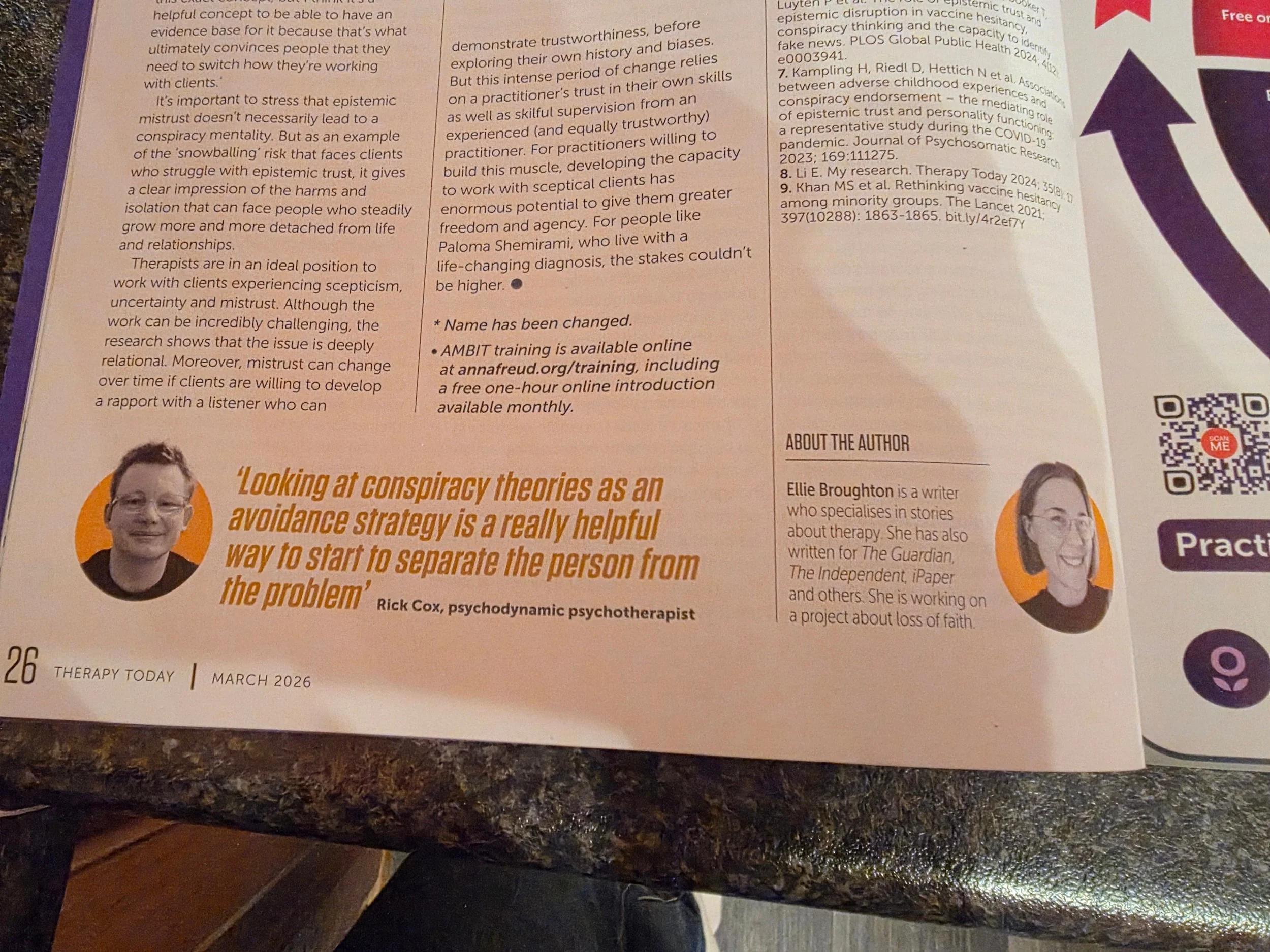
“Looking at conspiracy theories as an avoidance strategy is a really helpful way to start to separate the person from the problem” - Rick Cox, Psychodynamic Psychotherapist
Featured in Therapy Today
A version of these themes was explored in a recent feature article in Therapy Today, the professional magazine of the British Association for Counselling and Psychotherapy
The article examines how therapists are working with clients who have become immersed in conspiracy narratives, and the importance of maintaining the therapeutic frame while addressing avoidance and mistrust.
You can read the full feature here:
The Big Issue – Therapy Today (March 2026)
Thank you to Ellie Broughton, for the original article, a writer who specialises in stories about therapy. She has also written for The Guardian, The Independent, iPaper and others.
Frequently Asked Questions About How therapists work in the age of misinformation, scepticism and conspiracy theory
-
Therapy Today is the professional magazine published by the British Association for Counselling and Psychotherapy (BACP).
It includes clinical discussion, practitioner perspectives, and commentary on issues affecting counselling and psychotherapy in the UK. It is a professional publication rather than a peer-reviewed academic journal.
-
The BACP provides a public directory of registered and accredited therapists.
When choosing a therapist, consider:
Whether they are registered or accredited
Their therapeutic approach
Experience with the issues you are bringing
How they describe their way of working
How the first conversation feels
Accreditation reflects additional professional standards. The quality of the working relationship remains central.
-
No. Holding unconventional or conspiratorial beliefs is not, in itself, a diagnosis.
In therapy, the focus is usually not on labelling the belief but understanding the emotional function it may serve. For some people, conspiracy thinking becomes a way of managing anxiety, shame or uncertainty.
-
Direct confrontation often increases defensiveness.
Therapy tends to explore what happens internally when the belief becomes active. The aim is to understand the sequence: what was felt, how anxiety rose, and how certainty provided relief. Working at this level is often more productive than debating content.
-
Conspiracy narratives can provide structure during periods of instability.
They offer coherence when life feels uncertain. They locate threat externally. They reduce ambiguity. This can temporarily lower anxiety.
Understanding this regulating function helps separate the person from the strategy.
-
Change usually depends on building emotional capacity.
As a person becomes more able to tolerate uncertainty, anger and vulnerability without immediately defending against them, reliance on rigid explanatory systems often decreases.
The shift is gradual. It tends to arise from experience rather than persuasion.
-
When conspiracy thinking is understood as an avoidance strategy, the belief system can be examined without attacking identity.
This reduces defensiveness and allows curiosity. Therapy then focuses on strengthening agency, emotional regulation and relational stability rather than arguing about information.
Written by Rick Cox, MBACP (Accred)
Psychodynamic Psychotherapist, UK & Online