What My Vinyl Collection Taught Me About Memory, Regulation, and Meaning
This reflection uses my vinyl collection as a way of thinking about memory, regulation, and meaning from a psychodynamic perspective.
Over time, I stopped organising records by genre or chronology. Instead, I began organising them by function. What settles the nervous system. What carries memory. What feels alive in the present. What is still forming.
The process began as practical organisation and gradually became a way of observing how experience is held and used over time.
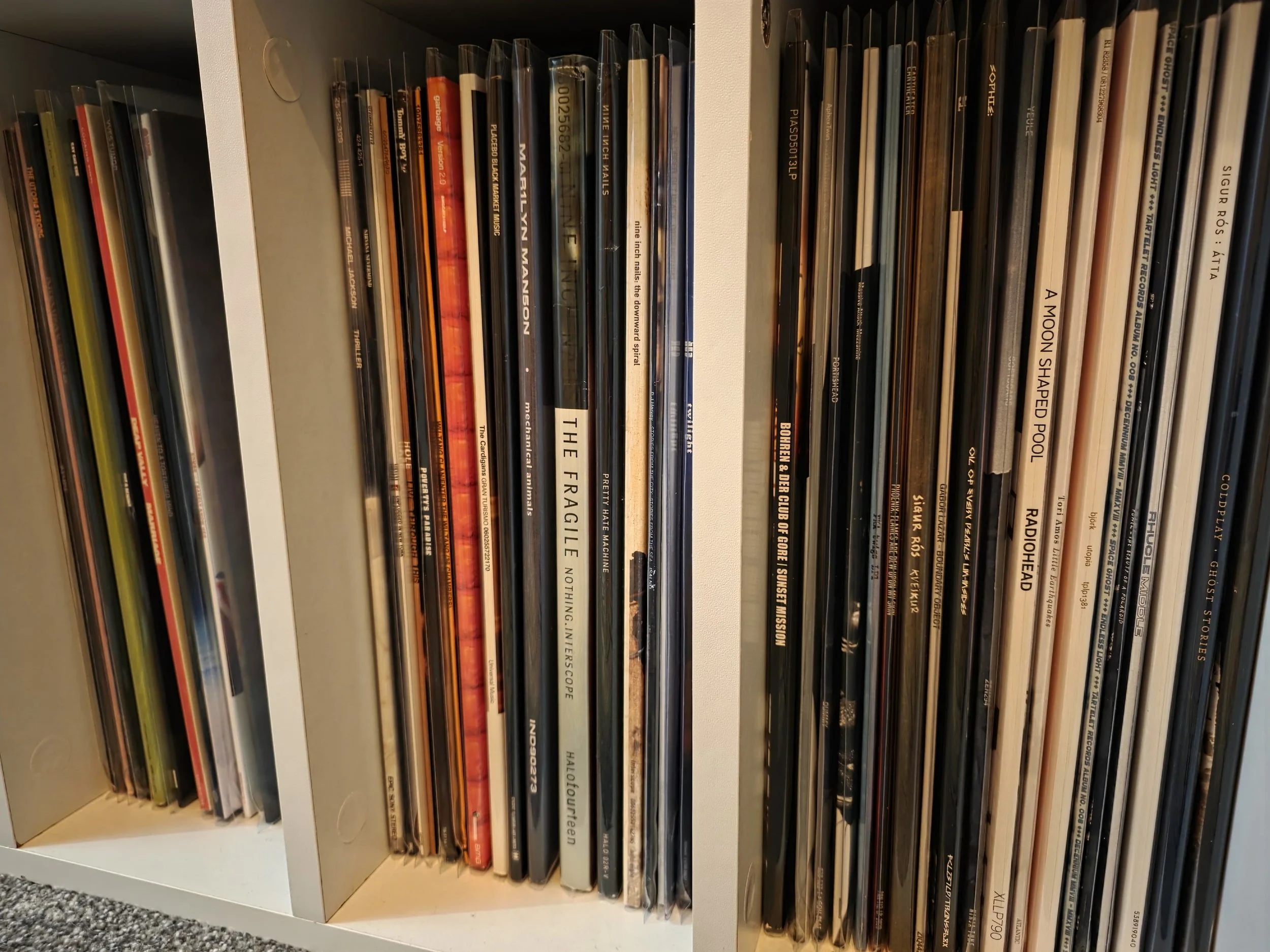
Part of my vinyl collection organised by psychological function rather than genre, with records that carry long-term memory and meaning grouped as Life Arcs.
From categorising music to noticing function
At first, organising records felt like a matter of taste or nostalgia. Eventually it became clear that something else was happening.
The question shifted from what is this album? to what does this album do?
Questions became more functional:
Does it regulate (how long can I stay with it?) or overstimulate?
Does it evoke a particular state?
Does it hold memory or belong to the present?
Do I return to it repeatedly?
Is it expressive, observational, or containing?
This way of organising mirrors psychodynamic thinking, which focuses on how experiences are used internally.
Arrival without pressure
New records now enter a section called Explore.
Nothing here needs meaning immediately. Material is allowed to arrive without being defined too quickly.
Nearby is Transitional Adult, where records feel current but not settled. Some fade. Some deepen. A few move into longer-term significance.
This reflects a familiar therapeutic principle. Experience often needs time before meaning becomes clear.
What endures
Only after some time do records move into Life Arcs.
These are albums that remain emotionally active over years. They mark periods of life or hold particular emotional continuity.
In therapy, some experiences pass through quickly. Others become part of the internal landscape. Life Arcs represent the latter.
Standout entries:
Hole, Live Through This
Nine Inch Nails, The Fragile
PJ Harvey, Stories From the City, Stories From the Sea
Agnes Obel, Aventine
Music as regulation
One of the most revealing sections is called States.
These records are less about narrative or identity. They function as environments that regulate the nervous system.
They are organised by emotional flow rather than meaning:
entry → immersion → pressure → fracture → release → after-state
This distinction matters clinically. Not all experience is symbolic. Some experience is primarily regulatory, and interpretation too early can interfere with its function.
Standout entries:
Aphex Twin, Selected Ambient Works
Massive Attack, Mezzanine
Eartheater, Phoenix: Flames Are Dew Upon My Skin
Sigur Rós, Kveikur
Meaning and voice
After regulation comes meaning-making.
Sections gradually move into:
Concept albums
Thematic and declarative work
Observational material
Inward and relational expression
Discharge
The sequence reflects a psychological reality. Expression lands differently depending on the degree of regulation that precedes it. Interpretation without stability can overwhelm. Expression without containment can become unstable.
Digital memory and liminal atmosphere
Electronic, synthwave, and vaporwave occupy a later section.
These records feel less autobiographical and more atmospheric. They carry mood rather than narrative, something closer to ambient memory than conscious recollection.
Clinically, this resembles early or less verbal psychological material. It is sensed rather than clearly told.
Standout entries:
Cat System Corp, Palm Mall
Waterfront Dining & Timeshare ’94, Couples Resort
Limousine, Paypal Playboy
Where the system ends
The collection ends with material I do not reinterpret.
My Pink Floyd records remain together, tied to specific childhood memories and shared experiences. They are less symbolic and more continuous, functioning as a stable point of emotional reference.
In psychological terms, they represent continuity rather than process.
Albums are organised by how they are used rather than what they are. Movement between sections happens slowly. The collection begins with openness and ends with inheritance.
Why this matters clinically
The most noticeable outcome was a real sense of flow and calm.
Nothing needed immediate explanation. New material could remain undefined. Older material no longer requires reinterpretation.
The system allows experiences to move, settle, or remain as they are.
That is also true in therapy. Structure creates stability so that meaning can emerge in its own time.
If this reflection resonated, you might explore:
Explore more psychotherapy in the media
Written by Rick Cox, MBACP (Accred)
Psychodynamic Psychotherapist, UK & Online
🎵 Creative work and music projects can be found here: Rick Cox Music